Kuka päivitti Simone de Beauvoir?
Jean-Paul Sartre päivitti Simone de Beauvoir ?: sta ?.: ään Ikäero oli 2 vuotta, 6 kuukautta ja 19 päivää.
Nelson Algren päivitti Simone de Beauvoir ?: sta ?.: ään Ikäero oli 1 vuotta, 2 kuukautta ja 19 päivää.
Claude Lanzmann päivitti Simone de Beauvoir : sta .: ään Ikäero oli 17 vuotta, 10 kuukautta ja 18 päivää.
Simone de Beauvoir
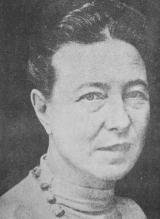
Simone Lucie Ernestine Marie Bertrand de Beauvoir (UK: , US: ; French: [simɔn də bovwaʁ] ; 9 January 1908 – 14 April 1986) was a French existentialist philosopher, writer, social theorist, and feminist activist. Though she did not consider herself a philosopher, nor was she considered one at the time of her death, she had a significant influence on both feminist existentialism and feminist theory.
Beauvoir wrote novels, essays, short stories, biographies, autobiographies, and monographs on philosophy, politics, and social issues. She was best known for her "trailblazing work in feminist philosophy", The Second Sex (1949), a detailed analysis of women's oppression and a foundational tract of contemporary feminism. She was also known for her novels, the most famous of which were She Came to Stay (1943) and The Mandarins (1954).
Her most enduring contribution to literature is her memoirs, notably the first volume, Mémoires d'une jeune fille rangée (1958). She received the 1954 Prix Goncourt, the 1975 Jerusalem Prize, and the 1978 Austrian State Prize for European Literature. She was also nominated for the Nobel Prize in Literature in 1961, 1969 and 1973. However, Beauvoir generated controversy when she briefly lost her teaching job after being accused of sexually abusing some of her students.
Lue lisää...Jean-Paul Sartre

Jean-Paul Charles Aymard Sartre (21. kesäkuuta 1905 Pariisi, Ranska – 15. huhtikuuta 1980 Pariisi, Ranska) oli ranskalainen filosofi, kirjailija ja yhteiskuntakriitikko. Hän oli eksistentialismin tunnetuimpia edustajia.
Sartren esikoisromaani on pohdintaa olemassaolon tarkoituksettomuudesta sisältävä romaani Inho (ransk. La nausée, 1938, suom. 1947). Hänen kirjalliseen tuotantoonsa kuuluu romaanien, novellikokoelmien ja näytelmien lisäksi filosofisia teoksia, esseitä ja lehtiartikkeleita. Sartrelle myönnettiin vuonna 1964 Nobelin kirjallisuuspalkinto, josta hän kuitenkin kieltäytyi.
Lue lisää...Simone de Beauvoir
Nelson Algren
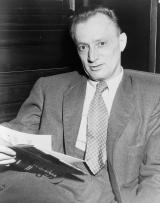
Nelson Algren (born Nelson Ahlgren Abraham; March 28, 1909 – May 9, 1981) was an American writer. His 1949 novel The Man with the Golden Arm won the National Book Award and was adapted as the 1955 film of the same name.
Algren articulated the world of "drunks, pimps, prostitutes, freaks, drug addicts, prize fighters, corrupt politicians, and hoodlums". Art Shay singled out a poem Algren wrote from the perspective of a "halfy," street slang for a legless man on wheels. Shay said that Algren considered this poem to be a key to everything he had ever written. The protagonist talks about "how forty wheels rolled over his legs and how he was ready to strap up and give death a wrestle."
According to Harold Augenbraum, "in the late 1940s and early 1950s he was one of the best known literary writers in America." A lover of French writer Simone de Beauvoir, he is featured in her novel The Mandarins, set in Paris and Chicago. He was called "a sort of bard of the down-and-outer" based on this book, but also on his short stories in The Neon Wilderness (1947) and his novel A Walk on the Wild Side (1956). The latter was adapted as the 1962 film of the same name (directed by Edward Dmytryk, screenplay by John Fante).
Lue lisää...Simone de Beauvoir
Claude Lanzmann
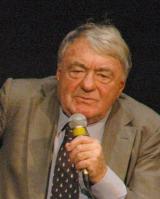
Claude Lanzmann (27. marraskuuta 1925 Pariisi – 5. heinäkuuta 2018 Pariisi) oli ranskalainen dokumentaristi. Hänen tunnetuin työnsä on yhdeksäntuntinen holokaustia käsittelevä Shoah (1985). Hänelle myönnettiin vuonna 1986 kunnia-César.
Lanzmann kuului Jean-Paul Sartren sisäpiiriin, ja hän kirjoitti freelancerina muun muassa France Dimanche -lehteen. Lanzmann teki televisioon reportaasia Israelin asevoimista Siinain niemimaalla ja sen jälkeen tuli Lanzmannin ensimmäinen elokuva Israel, Why.
Lanzmannin toinen elokuva oli holokaustidokumentti Shoah (1985), jonka hän kuvasi 1970-luvulla Puolan-matkoillaan. Noin yhdeksän ja puoli tuntia kestävässä elokuvassa holokausti esitetään ilman arkistomateriaalia ja musiikkia. Siinä on vain puolalaisia maisemia sekä juutalaisten, saksalaisten ja puolalaisten haastatteluja.
Lanzmann palasi holokaustiaiheeseen elokuvassaan Le dernier des injustes. Vuonna 2013 julkaistu elokuva keskittyy vuonna 1975 tehtyihin haastatteluihin, joissa Lanzmann keskustelee Theresienstadtin viimeisen vanhimman, wieniläisen rabbin Benjamin Murmelsteinin kanssa. Dokumentin nimi on väännös André Schwarz-Bartin teoksen Viimeinen vanhurskas alkuperäisestä ranskankielisestä nimestä Le dernier des Justes, joka on Murmelsteinin itsestään käyttämä nimitys..
Lanzmann julkaisi vuonna 2017 dokumentin Napalm, joka kertoo hänen vierailustaan Pohjois-Koreassa 1950-luvulla. Vain viikko ennen Lanzmanin kuolemaa ilmestyi hänen viimeinen dokumenttinsa, neljä ja puoli tuntia kestävä elokuva, joka keskittyy neljän holokaustista selviytyneen haastatteluihin.
Lue lisää...